
A living room touches more of the house than any other room project. The decisions that matter get made before anyone picks a paint color, and four questions do most of the work. Is the wall you want removed carrying load? That is the difference between a two-day job and a twelve-to-twenty-thousand-dollar one. Does the house predate 1978? If so, federal law requires an EPA-certified firm to disturb painted surfaces in it. Where do the switches, outlets, and low-voltage runs land? Settle that before drywall. And what is the room’s actual focal point? Decide it before the furniture. Get those four right and the finish decisions get easy.
Key Takeaways
- A non-load-bearing wall opening is usually a one or two day job. A load-bearing span with a flush beam can run twelve to twenty thousand or more, and no honest price exists before someone looks at the framing above.
- Federal law requires firms working in pre-1978 housing to be EPA lead-safe certified, and EPA publishes a searchable list you can check before you sign anything.
- Textured ceilings in homes built before the mid-1980s may contain asbestos. Intact material can be left alone; remodeling is the disturbance that changes that.
- A removed wall often carried ducts or a return, and the combined room afterward shares airflow the system was never balanced for. Raise it while the ceiling is open.
- Switch, outlet, and low-voltage locations get walked with your contractor before rough-in. It is a thirty minute conversation that prevents most of the regrets.
- Running one mid-grade floor continuously through three rooms beats a higher-grade material broken by a transition strip every twelve feet.
A living room remodel sounds simple on paper. New paint, new layout, maybe knock out a wall to the kitchen, done. In practice it is almost always the room that touches the most other rooms in the house, which means decisions you make here ripple into the kitchen, the dining area, the entry, and sometimes the upstairs framing.
We have remodeled living rooms across the Des Moines metro, from 1960s ranches in Beaverdale to newer builds in Waukee and Ankeny. The projects that turn out best have a few things in common, and they are not always what homeowners are thinking about on day one.
Whether the wall you want to remove is load-bearing
The most common ask we get on a living room project is whether the wall can open up to the kitchen. The answer is almost always yes. What it costs depends entirely on whether that wall is carrying load.
A non-load-bearing removal is usually a one or two day job: framing, drywall, and an electrical reroute if there are switches or outlets in the wall. A load-bearing wall is a different project. You are paying for a structural engineer to size a beam, an LVL or steel beam to replace the wall’s load path, temporary shoring during the cut, and a building permit. In our market that runs from a few thousand dollars for a simple non-load-bearing opening to twelve to twenty thousand or more for a long load-bearing span with a flush beam, meaning one tucked up inside the ceiling instead of dropping below it.
There is a second thing that wall may be doing. Supply ducts and cold air returns often run inside it, and removing it means rerouting them, which is mechanical work with its own permit. Then there is the part people discover the following August. Two rooms that were conditioned separately are now one volume, sharing whatever airflow the system was originally balanced for. If the living room had one supply and the kitchen had two, the combined space may need a different arrangement. Raise it during design. Adding a run is straightforward while the ceiling is open and awkward once it is closed.
If a contractor gives you a wall-removal price before looking at the framing above, and ideally at the original plans, push back. That number is not real yet. We went further into beam sizing, load paths, and what governs whether a beam can sit flush in our guide to kitchen layout, since the same wall usually serves both rooms.
What is in the walls if the house is older
This is the section most likely to change who you can legally hire, and it almost never comes up until someone is already holding a hammer.
Lead paint, if the house predates 1978. The EPA’s Renovation, Repair and Painting Rule requires any firm paid to disturb painted surfaces in pre-1978 housing to be EPA lead-safe certified, with a certified renovator assigned to the job. It covers general contractors and trades alike, including sole proprietors. Firms cannot legally advertise or perform covered work without it. It triggers on interior work disturbing more than six square feet in a room, which a wall opening clears immediately, and your contractor owes you EPA’s Renovate Right pamphlet before work begins. Given how much of Des Moines was built before 1978, this is a real question here rather than a technicality. EPA publishes a searchable list of certified firms. Ask, and verify.
Asbestos in a textured ceiling. Textured and popcorn ceilings in homes built before the mid-1980s may contain asbestos. EPA’s guidance is the useful frame here: material in good condition that will not be disturbed should be left alone and does not need testing. Remodeling is exactly the disturbance that changes the answer. So if your plan touches the ceiling, test first, and have an accredited asbestos professional take the sample rather than doing it yourself. EPA is explicit that improper sampling can be more hazardous than leaving the material alone.
Plaster and lath instead of drywall. Older Des Moines homes frequently have it, and it changes the work. Plaster cracks in sheets when adjacent framing moves, it does not patch the way drywall does, and running new electrical through it is slower. None of that is a reason to avoid the project. It is a reason the labor number on an older house is higher than a quote based on a newer one.
Where your switches and outlets are going to land
This sounds like a boring detail. It is the detail that determines whether the finished room feels right.
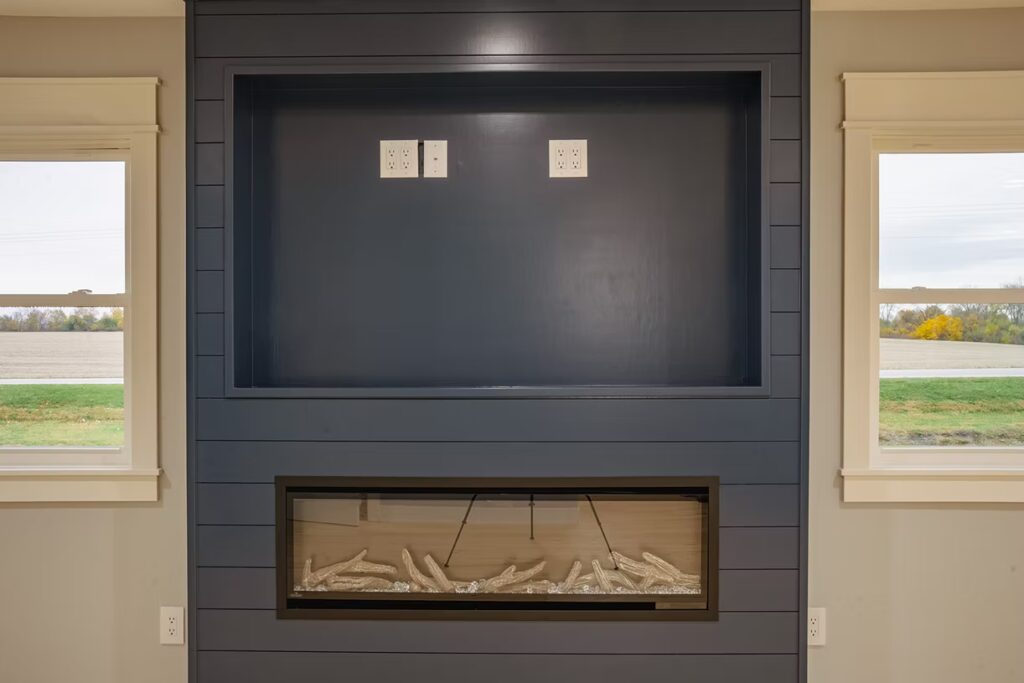
Walk the room with your contractor before electrical rough-in and think about how you actually live in it. Where will the couch sit, and do you need outlets behind it for lamps and chargers? Where will the TV go, and is there power and low-voltage cable in the wall behind it so cords stay hidden? Where do you want the switch for the recessed cans, and should it dim? Three-way switches at both entries to a room are cheap during construction and worth their weight once you are living there.
We do this walkthrough with every client before drywall goes up. Thirty minutes, and it prevents most of the “I wish I had thought of that” moments later.
Layered light, planned as a system
A single overhead fixture is the lighting equivalent of one large flashlight pointed at the ceiling. Harsh, flat, and the main reason most living rooms feel less comfortable than the homeowner expected.
Layered light means three sources working together. Recessed cans for general light, on a dimmer, always. Lamps and sconces at sitting height for warmth and reading. Accent light on a focal point: art, a built-in, a fireplace surround. Each layer goes on its own switch so you can run them independently. Movie night uses one combination, a dinner party uses another.
If you are not opening the ceiling for another reason, retrofit cans that install through a small hole without an attic visit make this far more affordable than it used to be.
Flooring continuity matters more than the flooring
If your living room flows into a dining room, kitchen, or entry, the transition between those rooms is a bigger visual decision than the color or the species. We would rather run a mid-grade engineered hardwood continuously through three rooms than use a higher-grade material broken by a transition strip every twelve feet.
- If you are replacing carpet with hardwood or luxury vinyl plank, plan the board direction. Long boards running parallel to the longest sight line make the space feel larger.
- Subfloor flatness matters more than people expect. Older Des Moines homes often have settled or uneven subfloors, and rigid plank will telegraph every dip. Self-leveling compound during prep is cheap insurance.
- If you are keeping existing flooring in adjacent rooms, bring a physical sample to the showroom when you pick the new material. Photos do not work for color matching, because lighting changes everything.
The focal point comes before the furniture
Most homeowners pick a couch first and then try to make the room work around it. The better order is to identify the focal point, then let everything else fall into place.
Most living rooms have one of three: a fireplace, a feature wall such as built-ins or paneling, or a window with a real view. The room arranges itself around whichever you pick. The TV is not a focal point. We mount TVs constantly, but ideally somewhere they can be present without dominating: at the right height above a mantel, inside a built-in with doors, or on a swing arm that tucks the screen against a wall when it is off.
If the fireplace is your focal point and you are changing it, know which project you are in. Refacing an existing firebox with tile, stone, or a new mantel is finish work. Converting a wood-burning masonry fireplace to a gas insert brings a gas line, venting, and a circuit. Removing or relocating a masonry chimney is structural, with a footing under it. Three very different prices, and homeowners routinely describe the third while budgeting for the first. Have the chimney and firebox inspected before you design around them.
If your living room is large enough for two seating areas, you can have two focal points and split the room into a conversation zone and a TV zone. That works well when the square footage genuinely supports it.
What Des Moines requires for a permit
Cosmetic work such as paint, flooring, and fixtures swapped on existing circuits generally does not need a permit. Wall removal, new circuits, and structural work do.
Des Moines runs permits through the Permit and Development Center at 1200 Locust Street, reachable at 515-283-4200. Run the city’s Show Me My House tool first, because a Des Moines mailing address does not always mean Des Moines jurisdiction in this metro. If you are in one of the city’s locally designated historic districts, exterior work carries an additional review. We pull permits on every project that needs one.
If a contractor offers to skip a permit to save you money, find a different contractor. It surfaces at resale, and it puts your homeowners insurance at risk if anything ever goes wrong.
Working with Elk River Contracting
Elk River Contracting is based in Ankeny and works with homeowners across the metro, including Des Moines, Waukee, Johnston, Urbandale, West Des Moines, and Clive. Cole handles the initial walkthrough on every project, and Emma Cross works with you through selections so the finished space holds together as one design rather than a collection of separate decisions. We are a registered Iowa contractor, license C144441, carrying general liability and workers’ compensation, with certificates shared before any contract is signed, and every project carries a one-year workmanship warranty in writing.
When you are comparing contractors, the differences usually show up in the details: how thoroughly they walk your space before quoting, how clearly the bid separates structural from finish costs, and whether they raise permit requirements, beam options, lead certification, and material lead times before you ask. Those are the conversations we would rather have up front. Fill out our contact form and we will be in touch within a business day.
Frequently Asked Questions
How long does a living room remodel take?
Cosmetic remodels covering paint, flooring, lighting, and fixtures usually run two to four weeks once material is on site. Add a wall removal and it is four to eight weeks. Add structural work, custom built-ins, or a fireplace rebuild and it stretches further. The biggest schedule variable is material lead time, especially tile, custom cabinetry, and certain lighting, so long-lead items get ordered as soon as selections are final.
What does a living room remodel cost in the Des Moines area?
Wide range, because the term covers everything from a paint and flooring refresh to opening three walls and rebuilding a fireplace. As rough orientation, cosmetic-only refreshes start in the mid four figures, mid-range remodels with new flooring, lighting, and a wall removal typically land in the mid five figures, and full projects with structural work, custom built-ins, and fireplace work can run into six figures. Any contractor should give you a real number after a walkthrough, not over the phone.
How do I check whether a contractor is lead-safe certified?
EPA maintains a public list of certified firms you can search by location, and a certified firm can produce its certification on request. If your house was built before 1978 and a contractor has never mentioned it, that tells you something. Ask for the firm certification and the name of the certified renovator who will be on your job.
How high should I mount a TV above a fireplace?
The center of the screen should sit roughly at standing eye level, which is usually lower than people instinctively want. If the mantel forces the screen uncomfortably high, the better answer is to lower the TV, build a recess into the surround, or move it off the fireplace entirely. Craning your neck through a two hour movie is a fixable problem, and it is worth fixing before the install.