
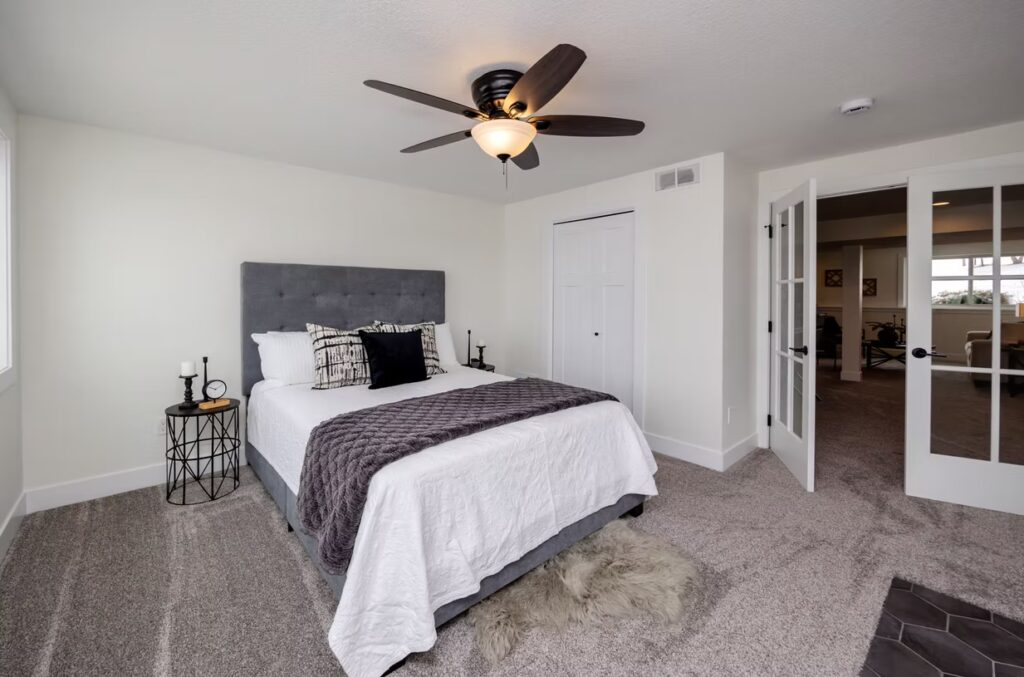
Adding a bedroom downstairs is one of the smartest ways to get more out of a Central Iowa home without adding a foot of footprint. The catch is that basements come with their own rules: less natural light, lower ceilings, trickier acoustics. Design choices that work upstairs don’t always translate.
We’ve finished a lot of basements in and around Ankeny, Des Moines, Waukee, and Johnston, and the finished basement bedrooms that turn out best almost always come down to a handful of decisions made early. Here are four worth talking through before you start.
First, the boring part: egress windows aren’t optional
Before we get to design ideas, one piece of practical info that gets missed a lot. In Iowa, a basement room can’t legally be called a bedroom unless it has a properly sized egress window. That means a window big enough for someone to climb out of in an emergency, with a window well that meets code if it sits below grade.
If you want this room to count as a bedroom for resale, for an appraisal, or just for guests sleeping safely downstairs, this is the first conversation to have with your contractor. We handle the cutting, the well, and the permitting as part of the project, but it’s the kind of thing you want priced into the bid up front, not discovered halfway through.
1. Light it like you mean it
Basement bedrooms get a reputation for feeling cave-like, but that’s almost always a lighting problem, not a basement problem.
The fix isn’t a single overhead can light. You want layered light. A few recessed cans on a dimmer for general light, a couple of wall sconces or bedside lamps for warmth, and ideally an LED strip somewhere (behind a headboard, under a bed frame, around a tray ceiling) for evening ambiance. If your egress window faces south or east, lean into it with breezy treatments instead of heavy blackout drapes.
Paint matters too, but probably not the way you’d think. Pure white tends to look gray and flat under artificial light. We usually steer clients toward a warm off-white with a little yellow or pink in it, or a soft mid-tone like a muted sage or blue that holds its color better under lamps than under daylight.
2. Design for guests, not just for show
A lot of the basement bedrooms we finish end up serving as guest rooms first and full-time bedrooms second. If that’s your situation, plan for it on day one.
That means a queen instead of a king (footprints matter down there), a small bench or dresser that can double as luggage drop, and the one people forget every time: actual empty closet hangers and empty drawers when guests show up. A bedroom that’s also being used as off-season storage doesn’t feel welcoming no matter how nice the paint is.
If you have the square footage, pairing the bedroom with a nearby three-quarter bath is a big upgrade for guest comfort and resale. We often lay out basements so the bedroom and bath share a plumbing wall, which keeps the runs short and the budget reasonable. For more on planning flexible, family-friendly basement layouts, we wrote about that separately.
3. Lean into the basement instead of fighting it
Some of the best basement bedrooms we’ve built didn’t try to pretend they were upstairs rooms. They leaned into what a basement actually is (a quieter, cooler, more enclosed space) and used finishes that made that feel intentional.
Wood-look luxury vinyl plank in a darker tone. A textured accent wall (we’ve done shiplap, vertical cedar, and limewash in basement bedrooms and they all hold up well). Warm metal fixtures instead of brushed nickel. Layered rugs. The goal isn’t to mimic a sun-drenched primary suite; it’s to make the room read like a deliberate retreat.
If you want to see how this looks in finished projects, our portfolio page has photos of several basements where this approach worked well.
4. Claw back every inch of ceiling height you can
Iowa basements often run 7’6″ to 8′ from slab to joists, and once you add HVAC trunk lines, plumbing, and a finished ceiling, you can lose six to ten inches fast. In a bedroom, that matters more than people realize.
A few things we do to get height back:
- Drywall instead of drop ceilings anywhere access isn’t required. Costs a little more; reads visibly taller.
- Soffits planned around mechanicals, not blanketing the whole ceiling. We map ductwork before drywall so soffits only run where they have to.
- Taller interior doors. A 7-foot door instead of the standard 6’8″ is a small change that makes the whole room feel taller.
- Vertical paneling or floor-to-ceiling drapery to draw the eye up.
If your basement has a few inches of give and you’re already opening the ceiling, it’s worth asking whether rerouting a duct or boxing in a beam differently is feasible. Sometimes it’s cheap; sometimes it isn’t. Worth knowing before you sign off on framing.
Frequently Asked Questions
Will adding a basement bedroom increase my home’s value?
Generally yes, as long as it’s a legal bedroom, meaning it has the egress window, a closet, and proper ceiling height. An unfinished basement room doesn’t add appraised square footage in most Central Iowa markets. A finished, legal one does. That’s the whole game.
How do I make a small basement bedroom feel bigger?
Light, mirrors, and continuity. We use built-in nooks and headboard walls a lot in tight basements. They let you skip a freestanding headboard and bulky nightstands, which eat square footage fast. Keeping the flooring continuous from the hallway into the bedroom (no transition strip) also makes the basement read larger as a whole.
What’s the most expensive part of finishing a basement?
Usually it’s the bathroom, by a fair margin. Plumbing rough-ins, tile, and fixtures add up quickly. After that, egress window installation if one isn’t already in place. The bedroom itself (framing, drywall, paint, flooring, trim) is typically one of the more affordable line items in a basement project.
What causes basement flooding, and should I worry before I finish?
In our area the usual culprits are surface water (poor grading, downspouts dumping right next to the foundation), hydrostatic pressure pushing groundwater through cracks, and failed sump pumps. Before you finish a basement, especially a bedroom where furniture and drywall will sit against exterior walls, it’s worth a full moisture assessment. We do one as part of our walkthrough, and if there’s a foundation or drainage issue, we’d rather find it before drywall goes up than after.
Thinking about a basement project in Central Iowa?
Elk River Contracting is based in Ankeny and we work with homeowners across the metro: Des Moines, Waukee, Johnston, Urbandale, West Des Moines, Clive, and the surrounding communities. Cole, our owner, handles the initial walkthrough on every project personally, and our design manager Lisa works with you on selections so the finished space feels like a continuation of your home rather than an afterthought.
If you’d like to talk through what’s possible in your basement, fill out our contact form and we’ll be in touch within a business day.