
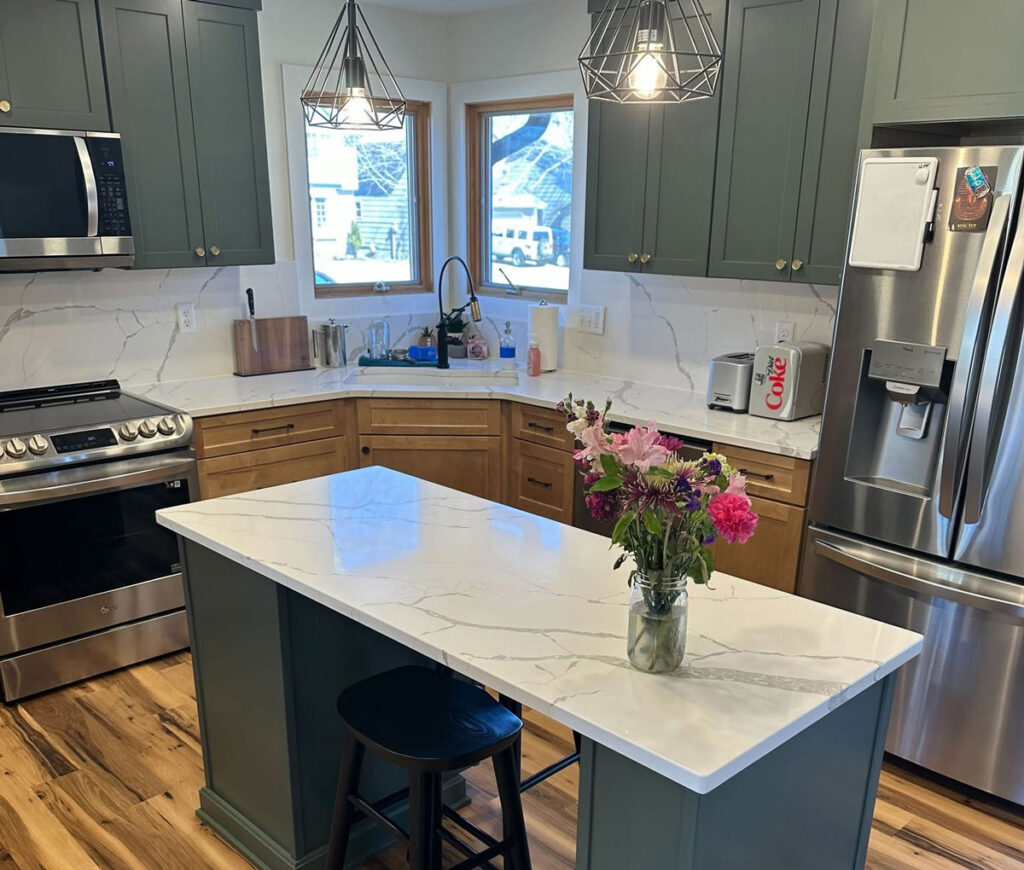
Most people plan a remodel in the wrong order. They start by asking what it costs, get a number, and then spend the next six months finding out everything that number didn’t cover. The better order is to decide what problem you’re actually solving, get an honest band for that scope, add a contingency you fully intend not to spend, and then work out whether the contractor sitting at your table will still be there in week nine. For reference, work across the Des Moines metro generally runs $15K to $30K for a guest bath, $30K to $70K for a primary, $40K to $100K and up for a kitchen, and $50K to $90K for a finished basement. Those numbers are the easy part. This is about everything that happens around them.
Key Takeaways
- Hold 10 to 15 percent back as contingency. On a house built before 1980 you will probably use some of it, and that’s not a planning failure.
- An allowance is a placeholder for something you haven’t picked yet, and an artificially low one is the most common way a competitive-looking bid stops being competitive.
- Ankeny reviews residential permit applications in about five working days, and no construction is allowed until the permit is issued.
- Iowa registers general contractors rather than licensing them, and there’s no competency exam, so a registration number confirms insurance and tax compliance and nothing about skill.
- Design and selections happen before the construction clock starts, which is why a twelve-week kitchen can be a five-month project.
Why “what does it cost” is the wrong first question
It’s the question everybody opens with, and we answer it, because refusing to talk about money is its own kind of red flag. We publish our ranges on every town page we have, including Ankeny and Des Moines. Go read them. They’re honest.
But a range is a starting point, and here’s the thing nobody tells you: two homeowners with identical kitchens and identical budgets routinely end up with wildly different projects, and the difference has almost nothing to do with the contractor. It’s what they decided, when they decided it, and how much they understood about what they were signing.
Cole put it this way in an interview with Welcome Home Des Moines: “A remodel project is a big deal for any homeowner, and the best remodelers respect that.” Respecting it means being straight about the parts that are genuinely hard. The construction isn’t the hard part. The decisions are.
So the useful version of the cost question isn’t “what does a kitchen cost.” It’s “what is going to move my project from the bottom of that band to the top, and which of those things do I control?”
How do you turn a range into your number?
Four things move a project inside its band, and you control three of them.
Whether the layout changes. Keeping the footprint is dramatically cheaper than moving it. The moment a wall comes out you’re into headers, possibly structural engineering, and almost always electrical rerouting. Moving plumbing is worse, because a drain has to fall, and where it can fall is decided by joists you can’t move.
The finish level. Semi-custom versus custom cabinetry is the single biggest swing in a kitchen. Tile is the second. This is where most of the range lives, and it’s entirely yours to decide.
How realistic your allowances are. An allowance is a placeholder dollar figure for something you haven’t chosen yet: tile, counters, lighting, plumbing fixtures. If the estimate carries $4,000 for countertops and you fall for a slab that runs $7,000 installed, your project just got $3,000 more expensive. That’s the allowance doing exactly what it’s designed to do. The trap is an estimate with allowances set low enough to make the bottom line look good, which is a real thing and worth watching for.
What’s behind the wall. This is the one you don’t control. Ungrounded wiring that has to come up to code once it’s exposed. Galvanized supply lines. A subfloor that’s been patched three times by three different people. None of it is exotic and none of it is anyone’s fault. It’s what a house that’s been lived in for sixty years looks like on the inside.
Which is why the contingency exists. Ten to fifteen percent, held back, that you plan not to spend. On a newer build in Ankeny, Waukee, or Bondurant you often won’t touch it. On a 1958 ranch off Merle Hay, plan on it.
Why do two bids for the same kitchen differ by $20,000?
Almost never because one contractor is greedy and the other is generous. It’s two different scopes of work, and your job is to find where they split.
Some of the gap is structural to the business. A firm with a downtown showroom, a full design department, and thirty years of overhead prices differently than a smaller shop does. Neither number is dishonest. They’re different companies with different cost structures, and you’ll see that spread across this metro if you get three bids. What matters is whether the number you’re handed matches the scope you’re being sold.
The rest of the gap is usually hiding in one of five places. One bid includes the electrical panel upgrade and the other doesn’t. The tile allowances differ by a factor of two. One covers permit fees and the other leaves them to you. One accounts for the fact that your 1972 bathroom has cast iron waste lines and the other never looked. Or one of them has a line for demo disposal and the other is planning to surprise you with it.
Here’s my honest opinion, and it’s the one thing I’d want a stranger to take from this article: a bid that comes in noticeably low for the scope described is usually not a bargain. It’s an estimate with things left out. You pay for them later, at change-order pricing, when the walls are open, you have no room to negotiate, and no other contractor in the metro can start next week.
To compare two bids properly you need both of them to show scope in real detail, every allowance and what it’s set at, the exclusions stated plainly, how change orders get priced and approved, and the draw schedule. If a bid is one page with a total at the bottom, that isn’t a comparison problem. It’s a document problem, and it tells you something.
How do you check out a contractor in Iowa?
This section will help you hire someone other than us, which is fine. A homeowner who knows what to ask gets a better project no matter who builds it.
Start with the words, because they matter here. Iowa doesn’t license general contractors the way some states do. It registers them. Any contractor earning at least $2,000 a year from construction work has to register with the Department of Inspections, Appeals, and Licensing, and you can look up anyone through DIAL’s contractor registration page. What that number proves is that the company met the state’s insurance and tax compliance requirements. It does not prove anyone passed a competency exam, because for general contractors there isn’t one. Registration is the floor, not the ceiling. Look it up anyway. It takes five minutes.
Then ask these, and pay attention to how fast the answers come:
- Can I see your certificate of insurance before I sign, covering general liability and workers’ compensation? Workers’ comp matters more than people expect, because an uninsured injury on your property can land on your homeowner’s policy.
- How long is the workmanship warranty and is it written into the contract? Terms in this metro run anywhere from one year to five. Get the number in writing rather than a verbal assurance, and be clear that a workmanship warranty is a different thing from whatever the cabinet or appliance manufacturer covers.
- Who is physically at my house every day, and who do I call when something’s wrong? If the answer is a rotating cast or a scheduling office, you’ve learned something.
- Are your electrical, plumbing, and HVAC subs licensed in their own trades, and are they people you use every week or whoever’s free?
- Can I see a project you finished in my town and talk to that homeowner?
Who pulls the permit, and how long does review actually take?
Your contractor should pull it. If a contractor suggests you pull the permit as the homeowner, that shifts liability onto you, and you should decline.
What people underestimate is review time, because it lands in the middle of your schedule rather than at the start. Two real examples from this metro:
- Ankeny takes about five working days to review a residential application, and ten working days or more for commercial depending on scope. No construction is allowed until the permit is issued, and inspections need 48 hours of notice. The city publishes separate application handouts for basement finishes, egress windows, interior remodels, decks, and additions, which is genuinely useful because it shows you exactly what the reviewer expects to receive. Start at Ankeny’s building information page and the permit applications page.
- Des Moines runs applications, payments, and inspection scheduling through the Permit and Development Center’s Customer Self Service portal.
Every town is different, so don’t accept a single rule covering all fourteen of them. Pleasant Hill runs on a Citizenserve portal. Waukee, Urbandale, Johnston, and Clive each have their own process and their own queue. And if you’re in a Des Moines historic district, a Certificate of Appropriateness through the Historic Preservation Commission gets added on top of the building permit, with its own review calendar. That one surprises people, and it isn’t optional.
What does the calendar really look like?
We publish typical construction durations on the town pages. The number that catches people out isn’t in those figures, though. It’s everything before them.
Design, selections, estimating, and permitting all happen before construction starts. A kitchen with a twelve-week build can easily be five months from first phone call to final walkthrough, and none of that front half is wasted. It’s where the project actually gets decided.
So work backward from the date that matters to you. Want the basement finished and in use by Thanksgiving? You’re having the first conversation in summer, not in October. Want a screened porch you’ll actually enjoy next year? Plan it over the winter, because by the second warm Saturday in April every calendar in Central Iowa is full.
One more thing about your own timeline, and this is where homeowners cost themselves weeks without realizing it. Selections delay more projects than construction does. If you take an extra three weeks landing on a cabinet door style, you have moved your own finish date by three weeks, because the crew can’t install what hasn’t shipped. Nobody is going to be annoyed with you about it. But you should know that the clock is yours during that stretch, not ours.
What happens once the crew shows up?
More predictable than most people expect, which is itself worth knowing:
- Demo. Loud, dusty, fast, and where anything hidden turns up. Protection goes up before it starts.
- Framing and structural. Walls out, headers and beams in, new openings cut.
- Rough-in. Electrical, plumbing, and mechanical run while everything’s open. Looks like nothing’s happening. A lot is.
- Inspection. The city looks before anything gets covered. Nothing proceeds until it passes.
- Insulation and drywall. It becomes a room again. This is the morale turning point on almost every job.
- Finish. Tile, cabinets, counters, trim, paint, fixtures. Feels slowest because visible progress per day drops.
- Punch list and final walkthrough. We walk it together and write down everything left.
The thing to sort out before day one is logistics, not construction. Where the crew parks, especially on a tighter lot in an older Des Moines neighborhood. Where the dumpster sits. Whether the dog needs to be somewhere else during demo. Small things, and settling them in advance is the difference between a project that feels organized and one that feels like an occupation.
Does any of this come back at resale?
Partly, and it depends on the project. Anyone quoting you a specific percentage is guessing.
If you want real figures, the annual Cost vs. Value Report from Remodeling magazine breaks cost and resale recouped down by project type and region. One detail matters a lot for anyone here: Des Moines is in the West North Central region, not East North Central. East North Central covers Ohio, Michigan, Indiana, Illinois, and Wisconsin, and the only Iowa city in it is Davenport. Use the West North Central report and pull the Des Moines city figures rather than the national averages, which run higher than what work actually costs here.
That said, resale return is a weak reason to remodel and a decent tiebreaker between two projects you were already weighing. Most of the people we work with aren’t planning to sell. They’re planning to stay, and they want a house that works better for the next fifteen years. A basement bedroom that lets a kid stop sharing a room has a return that doesn’t show up in any report.
Where Elk River Contracting fits
We’re a family-owned design-build remodeler based in Ankeny, founded in 2022 by Cole and Marquel Stuedemann, working across the metro on kitchens, bathrooms, basements, additions, and outdoor living. Design and construction sit under one roof, so you aren’t hiring a designer, then finding a builder, then refereeing between them.
We’re also four years in, which is worth saying out loud rather than dressing up. Cole joined the Remodelers Council of the Home Builders Association of Greater Des Moines specifically to learn from people who’ve been doing this a lot longer, and he co-chaired the Council’s 25th Anniversary Tour of Remodeled Homes in 2025. There are firms in this metro with thirty years and longer warranties than ours. What we compete on is the thing this whole article is about: you know the number and the sequence before demo day instead of discovering them during. See how that plays out in the portfolio, including the SW Ankeny kitchen and the Elkhart full remodel and addition.
Frequently Asked Questions
What’s the difference between an estimate and a bid?
In practice most people use them interchangeably, but the useful distinction is how binding the number is. A fixed-price bid commits to a total for a defined scope, with anything outside that scope handled by change order. A cost-plus arrangement bills actual cost plus a fee. Either can be fair. What matters is that you know which one you’re signing and what happens when the scope moves.
Should I get three bids?
Two or three is plenty, and only from firms you’d actually be comfortable hiring. Collecting six bids to find the lowest is how people end up choosing on a number that was never real. Compare the scopes side by side before you compare the totals.
What is a draw schedule?
It’s the agreement about when money moves during the project, usually tied to milestones rather than dates. A reasonable draw schedule keeps payments roughly in step with completed work. Be cautious of anyone asking for a very large share up front before materials have been ordered.
What happens if you find something behind the wall?
You get told, in writing, with a price, before the work happens. That’s what a change order is for. The version of this that goes badly is when a contractor keeps working and mentions it on the invoice, so ask up front how change orders get approved and whether anything proceeds without your signature.
Is it cheaper to be my own general contractor?
Sometimes, on paper. You’re taking on scheduling every trade in the right order, chasing them when they don’t show, carrying liability, pulling permits in your own name, and eating the cost when a mistake means the tile guy arrives before the shower pan is ready. Some people genuinely enjoy it and do it well. Most discover the savings were the fee for someone else absorbing all of that.
Where to start
If you’re six months out and just trying to work out whether the thing you have in mind is a $40,000 project or a $90,000 one, now is a better time for that conversation than later. Take a look at the portfolio, or get in touch and we’ll start with a phone call about what you’re trying to fix.